Fokus Artikel: Mit Künstlicher Intelligenz - Revolution auf St. Pauli: Hamburger Firma entwickelt bahnbrechende Technik für Krebsdiagnose

August 4, 2020
Das Hamburger Unternehmen "Mindpeak" entwickelt eine innovative Technik zur Diagnose von Krebs. Künstliche Intelligenz soll das Erkennen von Tumorzellen beschleunigen und sicherer machen - und den Ärzten mehr Zeit für die Patienten ermöglichen.

Kaum eine Erkrankung ist so sehr gefürchtet wie Krebs. Fast 240.000 Menschen sterben jedes Jahr daran – Tendenz steigend. „Es gibt immer mehr Krebsfälle auf der Welt, aber die Anzahl der Ärzte, die auch diese Krebsdiagnosen erstellen können, bleibt mehr oder weniger gleich“, sagt Felix Faber im Gespräch mit dem „NDR“.

Hamburger Firma "Mindpeak" entwickelt innovative Technik zur Ermittlung von Krebs

Deswegen hat Faber die Firma "Mindpeak“ ins Leben gerufen. Das auf St. Pauli ansässige Unternehmen entwirft Technik, anhand derer die Diagnose von Krebs vereinfacht und beschleunigt werden soll.

Dabei kommt Künstliche Intelligenz zum Einsatz. Diese untersucht die Gewebeprobe, die Grundlage für nahezu jede Krebsdiagnose ist, auf potenzielle Tumorzellen. Sie prüft, ob und wie viele Krebszellen vorhanden sind und welcher Art diese sind.

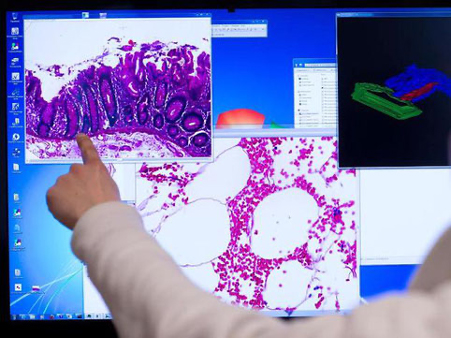
„Zuerst markieren wir den Bereich, den wir analysieren wollen. Dann wird das an unseren Server gesendet und innerhalb weniger Sekunden hat unser System, unsere Künstliche Intelligenz, die Tumorzellen von den Nicht-Tumorzellen differenziert und auch geschaut, welche Tumorzellen markiert sind, um so eine Prozentzahl auszurechnen “, erklärt Faber. Diese würde den Onkologen bei der Wahl der richtigen Therapie unterstützen.

Software von Hamburger Unternehmen ist Ärzten bei Diagnose von Krebs

Generell ist die Software den Ärzten eine enorme Hilfe. Denn normalerweise müssen die Mediziner die Krebszellen mit bloßem Auge auf einem Bild bewerten und händisch auszählen.

Und das kostet nicht nur Zeit, sondern auch Kraft: „Wenn Sie große Flächen auszählen sollen, da können Sie schon mal ein bisschen müde werden. Oder wenn es um die Beurteilung von sehr kleinen Pünktchen in Zellen geht, wo man 1.000 Zellen auszählen muss“, sagt Professor Markus Tiemann des Instituts für Hämatopathologie. „Da ist es tatsächlich so, dass solche Systeme die Konzentration sicherlich besser halten können als wir Menschen.“

Hamburger Firma: "Künstliche Intelligenz kann dem Arzt mehr Zeit für Patienten ermöglichen"

Doch obwohl die Künstliche Intelligenz das Erkennen von Tumorzellen deutlich vereinfacht, ist diese Software nur eine Hilfestellung. Letzten Endes stellt immer noch ein Mensch, nämlich ein qualifizierter Arzt die Diagnose Krebs, die über Leben und Tod entscheidet.

Doch mit Hilfe von "Mindpeak“ können sich Mensch und Maschine gegenseitig ergänzen, erklärt Faber. Denn die medizinische Zukunft gehöre der Zusammenarbeit: "Ich denke, die Künstliche Intelligenz in circa zehn Jahren kann Ärzte und das Gesundheitssystem sehr gut unterstützen bei Tätigkeiten, die sich häufig wiederholen. Künstlicher-Intelligenz-Software kann da einfach Arbeit abnehmen und so dem Arzt mehr Zeit für den Patienten ermöglichen“, erklärt der Geschäftsführer Faber.

Einschätzung von WHO: Bis 2040 steigt die Zahl der Krebserkrankungen um 60 Prozent

Vor allem vor dem Hintergrund, dass die Zahl der Krebserkrankungen laut WHO bis zum Jahre 2040 um 60 Prozent steigen könnte, ist dies von hoher Relevanz. Wie Fachleute schätzen, werden bereits 2020 mehr als 500.000 Menschen die Diagnose Krebs erhalten.

Nach Angaben von „Pharma Fakten“, einer Initiative von Arzneimittelherstellern in Deutschland, darf aber mehr als die Hälfte der Betroffenen darauf hoffen, wieder zu genesen. Das liegt auch am technischen Fortschritt – zu dem auch "Mindpeak“ von St. Pauli beiträgt.

Read the article online.

In the News

Related reading

In the News
8 min read

Redefining HER2-ultralow Detection: Mindpeak & AstraZeneca at ASCO 2025

Mindpeak GmbH is looking back at an unforgettable experience at this year’s ASCO2025!

Seeing our work presented in front of 2,000+ experts on the world’s leading oncology stage was more than an honor - it was a defining moment in Mindpeak’s mission to transform cancer diagnostics with AI.

This year stood out as we reached key milestones - most notably, unveiling the transformative results of our collaboration with AstraZeneca, driving the evolution of breast cancer therapies.

Key Highlights:

AI-powered HER2-ultralow detection: Our technology, deployed in one of the world’s largest clinical studies, enabled HER2-ultralow detection at scale - supporting AstraZeneca's Enhertu clinical program.

Clinical Impact: As seen in our session, our AI was instrumental in generating reproducible, high-quality data that contributes to more personalized treatment strategies for breast cancer patients.

Digital pathology at center stage: With our tech featured across multiple sessions and posters, Mindpeak's vision of accessible, automated cancer diagnostics is becoming a reality.

#ASCO2025 wasn't just about showcasing innovation - it was about proving real-world impact.

We’re building AI that scales, adapts, and empowers clinicians worldwide. The response we received confirmed: we’re solving the right problems, in the right way.

A heartfelt thank you to our partners at AstraZeneca, to the many labs and clinicians who made this possible, and to the incredible team at Mindpeak. Your dedication and ambition are the heartbeat of this movement.

Let’s keep pushing forward - the future of AI-driven cancer care is happening now.

In the News
8 min read

AI-Supported Pathology Training Presented at ASCO 2025 in Collaboration with AstraZeneca

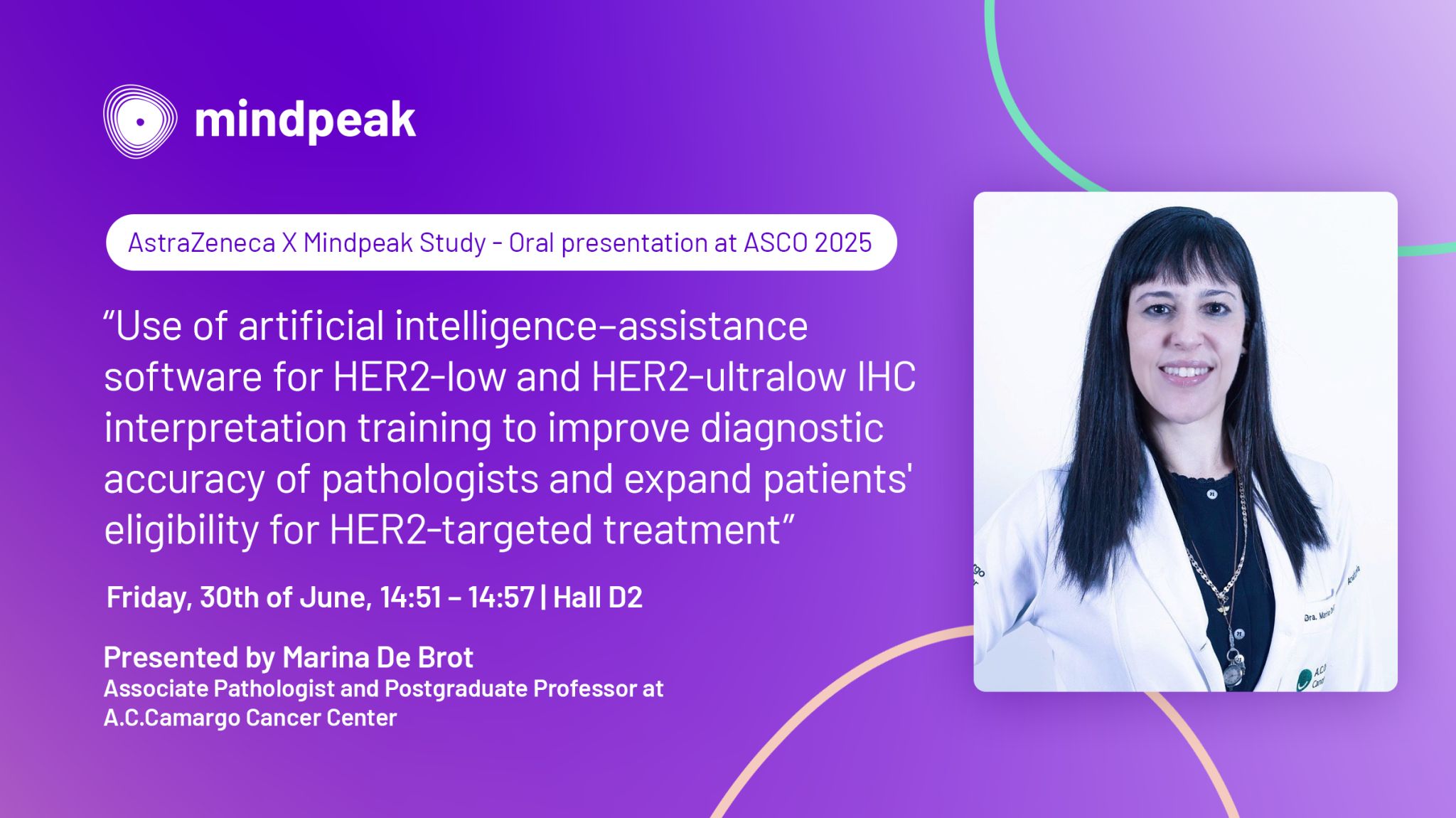
We were proud to present our collaborative research with AstraZeneca at the 2025 American Society of Clinical Oncology (ASCO) Annual Meeting. The study, focusing on AI-assisted training for HER2 IHC interpretation, was delivered by Marina De Brot on Friday, May 30th, in Hall D2, in Front of over 2000 people.

Enhancing Diagnostic Accuracy in HER2-Low and HER2-Ultralow Breast Cancer

The classification of HER2-low—and the emerging HER2-ultralow category - has become increasingly significant with the advent of HER2-targeted antibody-drug conjugates such as Enhertu. These therapies are providing new treatment options for patients with minimal HER2 expression, underscoring the importance of accurate diagnostic interpretation.

However, differentiating IHC 1+ from IHC 0, particularly in cases of faint membrane staining, remains a major diagnostic challenge. In line with the 2025 ASCO Annual Meeting theme introduced by ASCO President Dr. Robin Zon, our work aims to improve diagnostic precision and expand equitable access to personalized cancer treatments.

Global AI-Enabled Training Initiative

To address this challenge, we deployed an AI-supported training program through the Mindpeak GmbH ComPath Academy. The initiative engaged 287 pathologists across 11 countries, providing standardized education and decision support on HER2 IHC scoring.

Impactful Results for Clinical Practice

The study results were both clinically and statistically significant. Notably, the AI-supported training led to a 40% increase in accurate identification of HER2-ultralow cases—potentially expanding access to life-extending targeted therapies for a broader group of patients.

As highlighted in coverage by OncLive following the official ASCO press conference, this research reflects the evolving standards in cancer care. Accurate identification of HER2-low and HER2-ultralow patients is now a critical component of therapeutic decision-making in both metastatic and early-stage breast cancer settings.

Empowering, Not Replacing, Pathologists

This initiative is not about replacing pathologists with AI - it’s about empowering them. By combining expert training with advanced AI tools, we aim to improve diagnostic consistency and ensure that more patients receive the therapies they need.

We extend our thanks to everyone who joined us at ASCO 2025 and look forward to continuing our work toward a more precise, equitable future in cancer diagnostics.

In the News
8 min read

Continuing the Story: AstraZeneca and Mindpeak GmbH present new real-world results on AI-assisted HER2 scoring at ASCO 2025

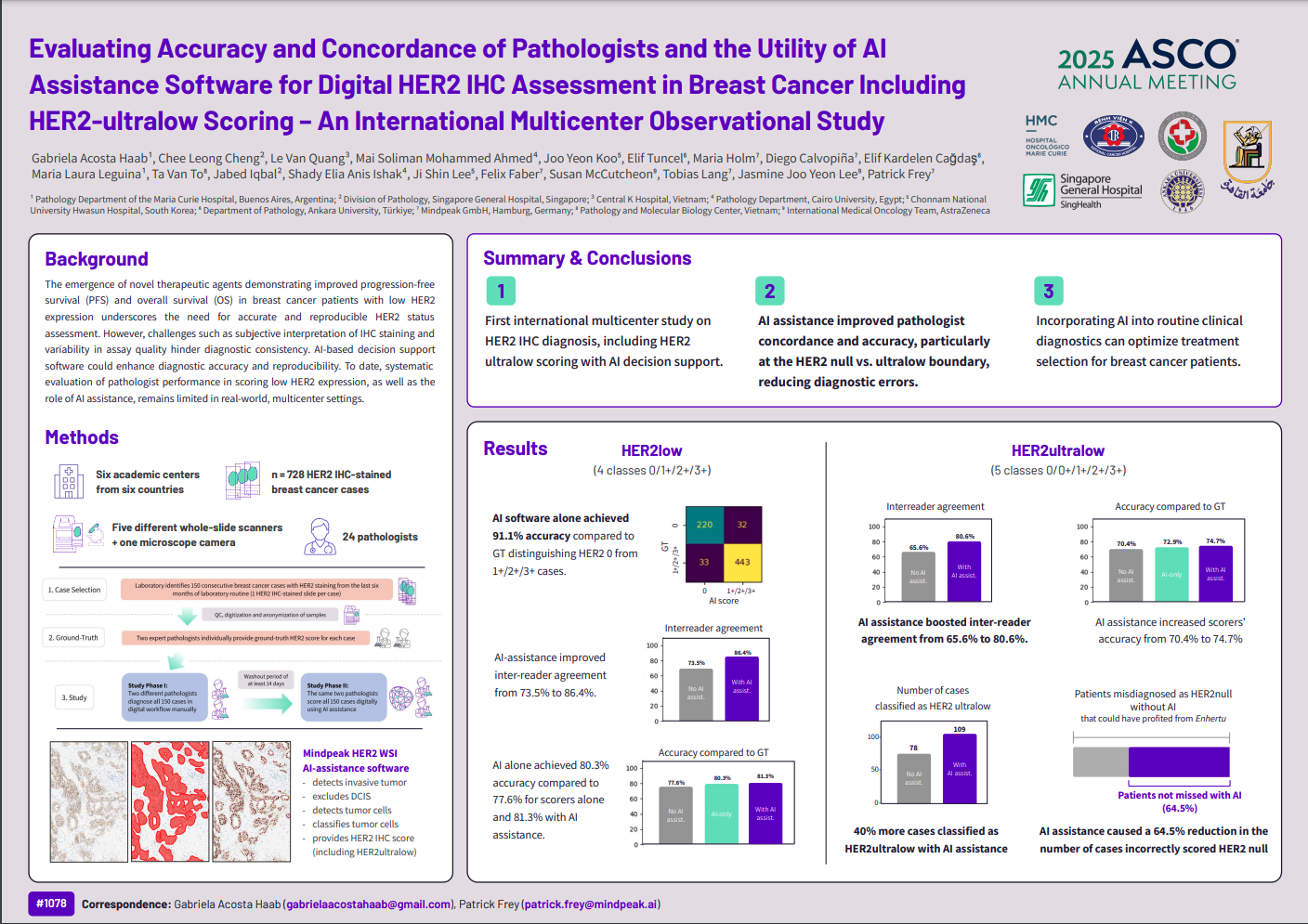
Continuing the Story: AstraZeneca and Mindpeak GmbH present new real-world results on AI-assisted HER2 scoring at ASCO 2025Following our oral presentation last Friday on the AI-assisted training for HER2 IHC interpretation, we are proud to share insights on the Monday’s poster session that took place at this year American Society of Clinical Oncology (ASCO) Annual Meeting.This time, it’s about  real-world diagnostics. In collaboration with six academic centers across the globe, we evaluated whether AI can truly enhance accuracy and consistency in daily pathology practice.And the answer is clear:AI support boosted diagnostic agreement  among pathologists to 86.4% for HER2-low and by 15% to 80.6% for HER2-ultralow - a major leap in consensus for some of the most challenging scoring decisions.Misclassification of HER2-null cases dropped by 64.5%, meaning more patients who may benefit from novel therapies like Enhertu can now be correctly identified.Accuracy rose across the board, especially in the critical 0 vs. 1+ distinction - an area long known for variability and clinical impact.Together, the oral and poster presentations offer a comprehensive view of how AI can support reproducible, high-quality HER2 assessment at scale - from training to clinical practice.As the clinical importance of HER2-low and ultralow scoring continues to grow, our findings provide strong evidence that AI can play a pivotal role in expanding access to targeted therapies like Enhertu - by enabling greater diagnostic precision.

Ready to advance your diagnostics

Connect with our team to explore how precision pathology works in your setting